

False Allegations vs. False Accusations
SOLDIER ON FIRE SERIES
False Allegations vs. False Accusations
Why the Difference Can Change Everything About Your Defense, Your Rights, and Your Future
"Let God be true and every man a liar."
— Romans 3:4 · By Master Sergeant Gustave · Soldier On Fire LLC
Here is a question that almost nobody in the middle of a false accusation thinks to ask — and that almost everybody should:

Most people — including, honestly, a lot of people in the legal system — use these two terms interchangeably. News anchors use them interchangeably. Your family members use them interchangeably. Even some attorneys use them interchangeably.
But they are not the same. They carry different legal weight. They require different defensive strategies. They produce different types of harm. And understanding precisely which one you are facing is the first step toward building a defense that actually works.
In this blog, we're going to break it all down: definitions, legal implications, real-world examples from today's legal culture, the unique danger of institutional betrayal that enables both, and what you can do right now if you're in the middle of either one.

Defining the Terms: A Distinction That Matters in Court
Let's start with clean, precise definitions — because precision is everything in legal matters.
What Is a False Allegation?
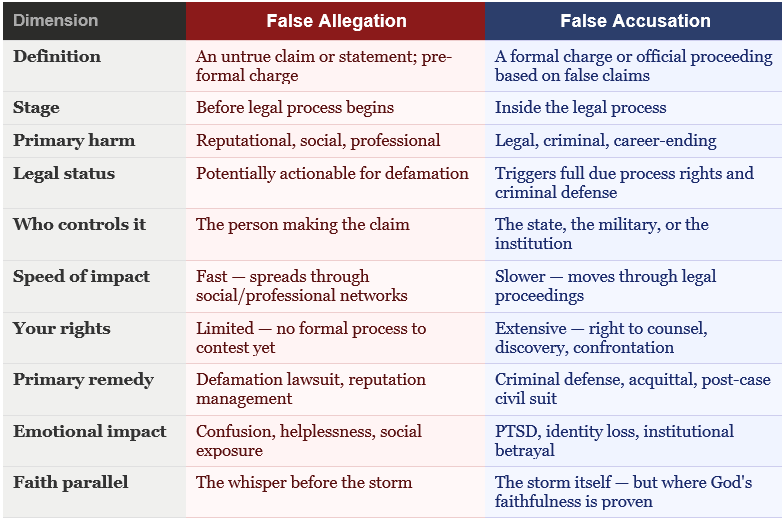
A false allegation is a statement or claim made about a person that is untrue — but the legal emphasis is on the statement itself. An allegation, in legal terms, is an assertion that something occurred. It has not yet been tested, proven, or adjudicated. It is a claim in motion.
A false allegation can be:
• Negligently false — the person making it genuinely believes it but is mistaken about the facts
• Recklessly false — the person making it didn't bother to verify it and made it anyway
• Intentionally false — the person making it knows it is untrue and makes it deliberately to cause harm
That third category — intentionally false — is where the allegation becomes something more than a claim. It becomes a weaponized statement. And it opens the door to significant legal liability for the person making it.
What Is a False Accusation?
A false accusation is broader. It encompasses not just a single statement, but the entire process of being formally charged, investigated, or prosecuted based on untrue claims. A false accusation is an allegation that has been institutionalized — it has entered the legal system, triggered official proceedings, and begun to produce real consequences for the accused.
The American Bar Association distinguishes between allegations (pre-formal-charge assertions) and accusations (formal charges or official proceedings) in its criminal justice standards. The distinction matters because:
• A false allegation may or may not result in legal proceedings
• A false accusation already has — and is actively reshaping the accused's life, rights, and reputation
• The remedies available to you differ significantly depending on which stage you're in

When an Allegation Becomes an Accusation: The Escalation Pathway
Understanding how a false allegation escalates into a false accusation is critical — because there are often intervention points along the way where the right legal move can stop or slow the process.
Stage 1: The Allegation Is Made
Someone makes a statement — to HR, to a commanding officer, to law enforcement, to a colleague, on social media. The statement may be vague or specific. It may be made privately or publicly. At this stage, you have the most opportunity to act.
What you do — and equally importantly, what you don't do — in the first 24-72 hours after you learn of an allegation can significantly affect the trajectory of everything that follows. Attorneys who specialize in this area consistently identify early engagement with legal counsel as the single most important protective step a person can take at this stage.
Stage 2: The Allegation Enters an Institutional Channel
Once a false allegation enters a formal channel — an HR complaint, a military report, a police report, a Title IX filing — the dynamics change immediately. The institution now has its own obligations, its own procedures, and its own interests. And those interests are not always aligned with yours.
This is the stage where institutional betrayal becomes a real risk. Research by Dr. Jennifer Freyd at the University of Oregon defines institutional betrayal as harm caused when an institution — a military branch, a university, an employer — fails to respond adequately to wrongdoing or actively creates conditions that worsen harm for those caught in its processes. This can happen to both the accuser and the accused, and it is more common than most people realize.
Stage 3: The Accusation Becomes Formal
A formal charge — a court-martial charge sheet, a criminal indictment, a civil lawsuit filing — marks the transition from allegation to accusation. You are now in the full machinery of the legal system. This is where Constitutional protections kick in fully:
• The right to counsel (6th Amendment)
• The right to confront witnesses (6th Amendment)
• The right to discovery — access to the evidence against you
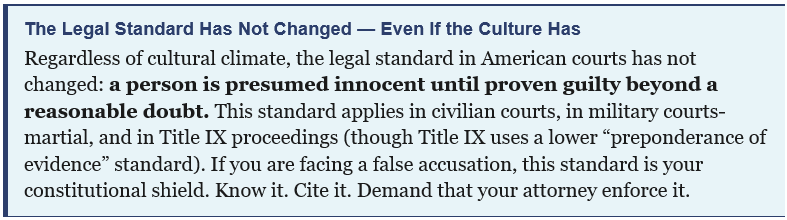
• The presumption of innocence (5th and 14th Amendments)
• In military cases: the full protections of the UCMJ and RCM
If you are at Stage 3, you need an attorney. Not a friend who knows a little about law. Not a paralegal. An attorney — ideally one who specializes in the specific type of proceeding you are facing.

Before Taking a Plea — Master Sergeant Gustave (Soldier on Fire Series)
A veteran's plain-language guide to understanding the military justice system before you sign anything. Know the difference between an allegation and a formal charge — and what your rights are at each stage.
Fabricating a Victim — Master Sergeant Gustave (Soldier on Fire Series)
How false victimhood is constructed, how institutional processes are weaponized, and how to recognize the patterns before they consume your case.
The Trial of the Century: How the Legal System Can Fail the Innocent — Alan Dershowitz
A legendary defense attorney's analysis of how the American legal system processes — and sometimes fails — the falsely accused. Essential background for anyone navigating a serious case.
Disclosure: As an Amazon Associate and Google affiliate partner, GFAM Ministries / Soldier on Fire LLC earns from qualifying purchases at no extra cost to you. Your support funds veteran advocacy and ministry resources.
The #MeToo Era: When Allegations Became Verdicts Before Trials
We cannot have an honest conversation about false allegations versus false accusations in 2025 without talking about the seismic cultural shift that the #MeToo movement triggered — and the complex legal and social landscape it created.
Let's be clear about something upfront: the #MeToo movement addressed a very real, very serious problem. Sexual harassment, assault, and misconduct in professional settings had been systematically underreported and underprosecuted for decades.
The movement gave voice to legitimate victims who had been silenced and enabled critical conversations about power, consent, and institutional accountability. And. At the same time. It created a legal and cultural environment in which allegations became public verdicts — often before any investigation, any evidence review, or any legal proceeding had taken place.
The Foundation for Individual Rights in Education (FIRE) — which tracks due process cases on college campuses — documented hundreds of cases in which students and faculty were expelled, fired, or suspended based on allegations alone, before any formal adjudication. The Presumed Innocent Project was founded specifically to address the growing number of cases where Title IX proceedings failed to provide adequate due process protections to the accused.
This cultural context is critical for understanding why the distinction between allegation and accusation matters so urgently today. In a climate where “believe all accusers” became a cultural rallying cry, the presumption of innocence — a foundational principle of American jurisprudence — was increasingly treated as a technicality rather than a right.
Institutional Betrayal: When the System Becomes the Weapon
One of the most under-discussed dynamics in false accusation cases — whether civilian or military — is the role that institutions themselves play in enabling, amplifying, or accelerating harm to the falsely accused.
Think about your own situation. Has any of the following happened?
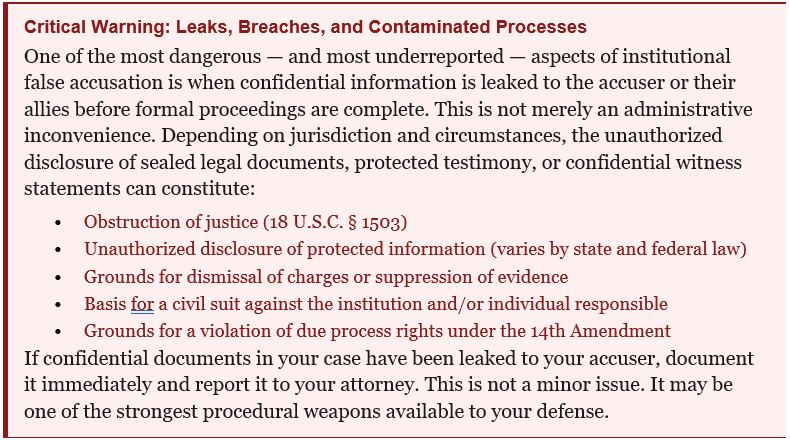
• Confidential documents, statements, or investigation details were shared with your accuser or their allies
• Personnel within the institution appeared to take sides before any investigation was complete
• Your accuser received information or access that they should not have had under proper procedure
• Informal alliances within the institution shaped the formal process in ways that disadvantaged you
• Due process protections existed on paper but were inconsistently enforced in practice
If you recognize yourself in any of those scenarios, you are experiencing what Dr. Freyd and other researchers call institutional betrayal. And it is not rare. A 2014 study published in the Journal of Traumatic Stress found that institutional betrayal — being failed by the very system that was supposed to protect you — compounds the psychological harm of the original trauma and significantly increases PTSD symptoms.
The Civilian Parallel: HR, Compliance, and Corporate Justice
This dynamic is not unique to the military. In corporate and institutional environments, the same patterns emerge:
• A complaint filed with HR triggers an investigation in which the accused has limited rights to confront evidence or question witnesses
• Informal relationships between the accuser and HR personnel, compliance officers, or management can create an "inside track" that compromises the objectivity of the process
• The Equal Employment Opportunity Commission (EEOC) has published guidance acknowledging that workplace investigations are only as impartial as the people conducting them — and that procedural failures can expose both parties to legal liability
• Leaked confidential information in workplace investigations can constitute a violation of employee privacy rights and, in some cases, a breach of fiduciary duty
The National Employment Law Project has documented cases in which employees were terminated based on false allegations before any formal investigation was completed, and in which the employer's failure to follow its own procedures created significant legal liability. If you are in a workplace false allegation situation, your employer's own written HR policies and procedures are critical evidence.
The Compassion Trap: When Trying to Help Gets You Burned
There is a psychological and legal dynamic in false accusation cases that almost never gets talked about, but that damages the falsely accused with surprising frequency:
The compassion trap.
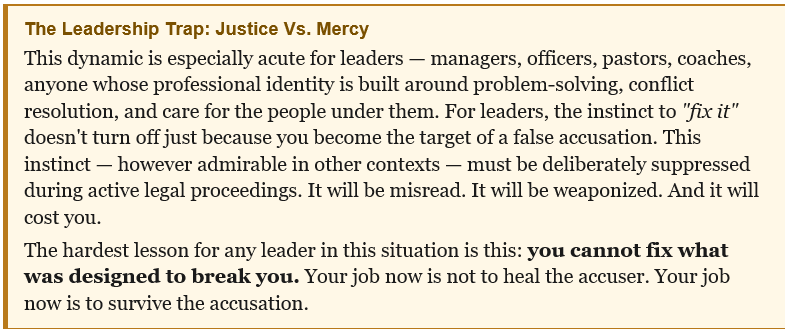
Here is how it works: You are facing a false allegation or accusation from someone you once tried to help — a subordinate, a colleague, a student, a client. And even as the legal process unfolds, even as the evidence of fabrication accumulates, you find yourself still feeling a sense of duty toward that person. A sense of responsibility. Maybe even compassion.
So you do something that seems, in the moment, like the right thing: you reach out. You advocate for leniency. You send an email asking for mercy. You make a phone call you shouldn't make.
And almost instantly, it is used against you.
Legally, any communication you initiate with your accuser, or on their behalf, during an active proceeding can be interpreted as evidence of inappropriate relationship, consciousness of guilt, or an attempt to influence the investigation. Your attorney is not overreacting when they tell you to cut off all contact. This is one of the most clinically documented patterns in false accusation cases: the accused's own well-intentioned actions become prosecutorial ammunition.

Liar, Liar, Soldier on Fire — Hardcover
The complete story of navigating institutional betrayal, false accusations, weaponized allegations, and the military justice system. The book that tells what the manuals don't.
Liar, Liar, Soldier on Fire — Audiobook
Listen during commutes, workouts, or quiet moments. Available on Audible. The audiobook edition brings every chapter to life — including the chapter on false allegations vs. false accusations.
A civil rights attorney's account of fighting false accusations and wrongful convictions in the American legal system. One of the most powerful books ever written about justice, mercy, and institutional failure.
Disclosure: As an Amazon Associate and Google affiliate partner, Soldier on Fire LLC earns from qualifying purchases at no extra cost to you. Your support funds veteran advocacy and ministry resources.
Your Legal Rights: What Changes at Each Stage
Let's get concrete about what your rights actually are — and what actions are available to you — depending on where you are in the allegation-to-accusation spectrum.
If You Are at the Allegation Stage (Before Formal Charges)
1. Consult an attorney immediately. Even before charges are filed. The sooner you have legal counsel, the more options you have to shape what comes next.
2. Document everything. Save every communication, every witness interaction, every professional record that establishes your character and the context of your relationship with the accuser.
3. Do not contact your accuser. Not to apologize. Not to explain. Not to express concern. Not to ask for leniency. Any contact will be used against you.
4. Understand your defamation rights. If the false allegation has been made publicly and is causing you reputational or professional harm, you may already have grounds for a defamation claim. Consult your attorney.
5. Protect confidential information. If you suspect that confidential information in your case has been leaked, report this immediately to your attorney. It may be grounds for dismissal, suppression, or a separate legal action.
If You Are at the Accusation Stage (Formal Charges Filed)
6. Exercise your right to counsel fully. This is not the time for a public defender if you can afford private counsel. This is the fight of your life.
7. Demand full discovery. You have the right to see all evidence against you, including the accuser's prior statements, communications, and relevant history.
8. Understand the standard of proof. In criminal court: beyond a reasonable doubt. In military court-martial: same. In Title IX/civil proceedings: preponderance of evidence (51%). Know which standard applies to your case.
9. Document all procedural violations. Every breach of due process, every leaked document, every procedural irregularity is potential ammunition for your defense and for future appeals or civil action.
10. Begin building your post-case civil case now. Even as the criminal or administrative case proceeds, your attorney should be cataloguing all damages — professional, financial, psychological, reputational — for a future defamation or malicious prosecution lawsuit.
What the Bible Says About False Witnesses
I opened this blog with Romans 3:4 — “Let God be true and every man a liar.” I want to come back to it here, because it is not just a theological statement. It is a legal and moral declaration.
It says: regardless of what people claim about you, regardless of how many voices are aligned against you, regardless of how convincing the false narrative sounds — truth has an ultimate authority that human testimony cannot override. The lies will be exposed. Not always quickly. Not always in the way you want. But the arc of truth is longer than the arc of deception.



Luke 8:17 is not metaphor. It is a promise. The hidden things — the leaked documents, the coordinated deception, the alliances built in the dark — have a shelf life. They do not stay hidden forever. Your job is to survive long enough to be there when the light comes on.
Final Word: Precision Is Power
Here is the takeaway I want you to leave with:
False allegation. False accusation. Two terms. Two stages. Two different sets of rights, remedies, and strategies. Understanding precisely which one you are dealing with — and at what stage — is not an academic exercise. It is a survival skill.
The system is not perfect. It can be slow, biased, and vulnerable to manipulation. Confidential information gets leaked. Informal alliances compromise formal processes. Compassion gets weaponized. Institutions fail the people they were designed to protect.
But the system also has rules. And those rules — when you know them, enforce them, and build a defense around them — can protect you.

Know the terms. Know your rights. Know your God.
You are still in the fight.
— Master Sergeant Everell Gustave
Author, Liar, Liar, Soldier on Fire | Founder, Soldier on Fire LLC
Connect with Soldier On Fire
Website: soldieronfire.net
Get the book: Liar, Liar, Soldier on Fire on Amazon